
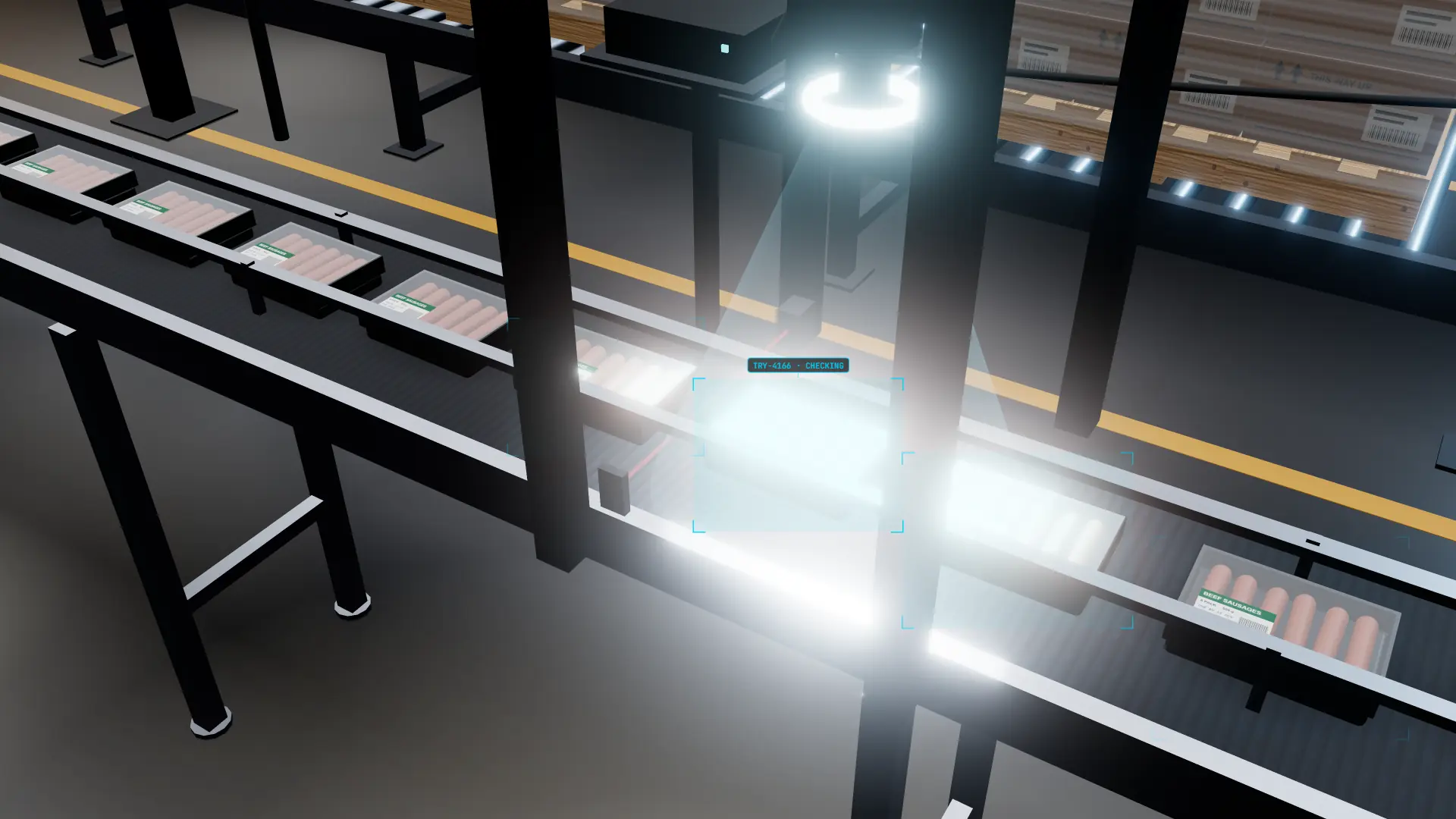
AI vision inspection for food and beverage lines
Industrial AI Vision inspects every bottle, can and pack through filling, sealing and labelling, so problems are caught before they become recalls.
Updated October 2026 · 3D simulation, illustrativeAn AI food inspection system for New Zealand food and beverage lines checks every bottle, can and pack for low fills, loose caps, wrong labels and foreign material. Each result is saved with its photo and time, ready for your food safety records and audits.
- Every item inspected inline
- Product-specific models for each pack size
- Built for wash-down and cold rooms
- A photo record for audits
- Validated on your production footage before go-live
Catch problems before they become recalls
Each check is trained in the Industrial AI Vision Lab (VLab) on your products and held to your own QA standards.
Fill level
Catches under- and overfilled bottles, cans and jars before they leave the line.
Caps and closures
Finds missing, loose or crooked caps that could leak or spoil.
Seals and tamper evidence
Confirms seals and tamper bands are intact on every pack.
Labels and allergens
Makes sure the right label and allergen information is on the right product.
Date and batch codes
Confirms every pack carries a readable, correct date and batch code.
Foreign material
Spots foreign material on product or in open containers before sealing.
Appearance and grading
Grades size, colour and shape against your product specification.
Damaged packs
Finds cracked jars, dented cans and split pouches before they reach a shelf.
Spot contamination while it’s still visible
Product is checked before it’s sealed, and the same cameras can watch hygiene on and around the line.
Foreign material and debris
- Anything foreign on the product or conveyor
- Debris in open containers before sealing
- Discolouration and marks on the product
Clean-down checks
- Residue left after cleaning
- Standing water
- A photo record of each check
Hygiene zones (optional)
- Hairnets, gloves and protective gear at entry points
- Cold-room doors left open
- Alerts to a supervisor, logged for review
Good to know: cameras see surfaces, so they work alongside your metal detection and X-ray, which see inside sealed packs. How computer vision cuts contamination risk.
Check the fill in every bottle and can
Each one is held to the fill limits your quality team sets, so underfills don’t reach customers.
- Clear bottles and jars: checked from the side.
- Cans and open containers: checked from above before the lid goes on.
- Sealed opaque packs: better suited to checkweighing or X-ray.
- Trends: a run of low fills is flagged to the shift lead early.
Have the evidence ready for every audit
Every inspection is saved with its photo, ready for your HACCP plan, customer questions and auditors.
It supports your food safety programme; sign-off stays with your QA team.
- A photo and time for every inspection
- Checks lined up with your HACCP control points
- Label and date-code proof for every run
- Automated shift and management reports
- Easy exports for auditors and customers
Integrated with the equipment on your line
Industrial AI Vision signals your existing reject equipment, so low fills and faulty packs are removed automatically, and results appear on your operator displays. How plant integration works.
Built for wash-down and cold rooms
Cameras and lighting are housed for wash-down, steam and cold, and placed so they don’t trap product or get in the way of cleaning. The model learns from your line in its real conditions, glare and condensation included.
Check at the points that matter
Typical spots are after filling, capping and labelling, and again before packing, with grading on intake if you need it.
Ready for every product you run
A product-specific vision model, developed in the Vision Lab, covers each flavour, size and label you run, and switches settings at changeover. See also label and date code inspection, packaging inspection and general manufacturing.
Move from spot checks to every pack
Spot checks cover only a fraction of what you make. See the real cost of manual inspection and the production line inspection overview.
Frequently asked questions
How does AI detect contamination on a food line?
Does it replace our metal detector or X-ray?
Does it support HACCP and food safety compliance?
Can it check fill levels in bottles and containers?
Will it cope with wash-down, steam and condensation?
Can it handle flavour, size and label changeovers?
Can it check hygiene gear at entry points?
Related pages and guides
Talk to us about your products
Tell us what you produce and where problems slip through, and we’ll show you what can be checked.