
AI and computer vision inspection for New Zealand production lines
Industrial AI Vision inspects every product on your line with a model trained on your products, so defects are identified before they reach a customer.
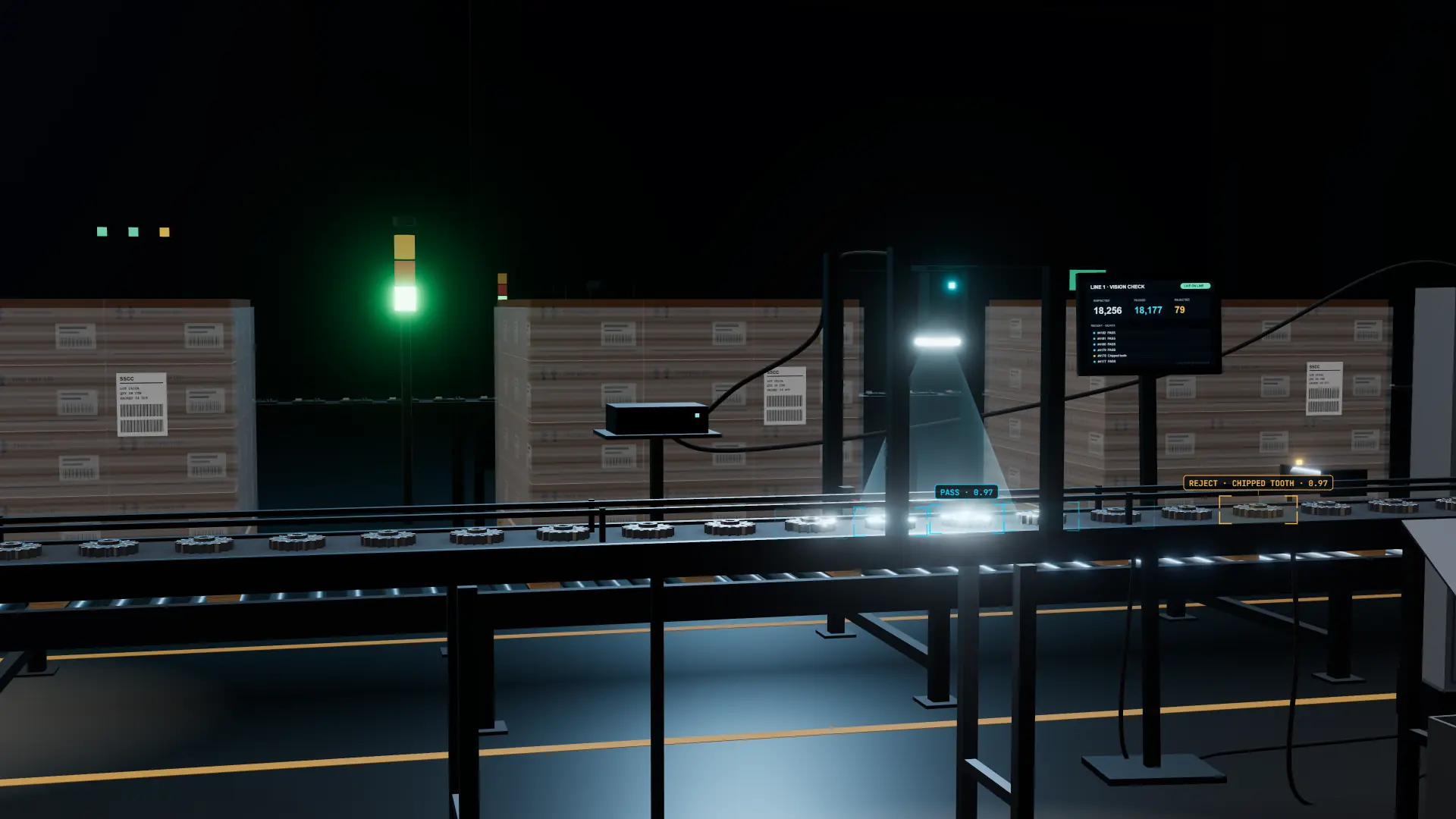
Updated October 2026 · 3D simulation, illustrativeIndustrial AI Vision is an AI vision inspection system for New Zealand production lines: machine vision that learns from your products rather than relying only on fixed rules. Each deployment uses a product-specific model developed in the Industrial AI Vision Lab (VLab), inspects every product inline, and connects into your plant’s existing systems, which act on any defect.
- 100% inline inspection
- Product-specific models, trained in the VLab
- Integrates with your existing plant systems
- Validated on your production data before go-live
- Edge deployment, with cloud options
Inspection for the defects that matter most
Each application is configured around your product and the standards your quality team works to.
Labels and print
Check the right label is on, straight and readable, with the correct code.
Missing parts
Confirm every part and feature is there before the item moves on.
Foreign material
Find contamination and foreign objects before product is packed and shipped.
Packs and pallets
Spot damaged packs, poor wrapping and missing labels at the end of the line.
Surface defects
Catch scratches, dents, chips and finish faults that are easy to miss by eye.
Assembly checks
Verify each assembly is complete, the right way round and built with the right parts.
Counts and flow
Count product and see gaps or jams on the conveyor as they happen.
Safety zones
Know when someone steps into the area around moving machinery.
Inline inspection, from capture to action
- 01
Image capture
Industrial cameras and lighting, specified for your product, capture a consistent image of every item.
- 02
Analysis against your standard
A product-specific model assesses each item and returns a pass or fail, with the defect type and confidence.
- 03
Action through your plant
The result is passed to your plant’s control systems, which trigger the reject equipment or flag the item. Plant integration.
- 04
Recorded and reported
Every result is stored with its image and timestamp, building a complete quality record across every shift.
Product-specific models, developed in the Vision Lab
Every model is developed in the Industrial AI Vision Lab (VLab), our model-training environment. It’s trained on images of your products and real defects, then validated against your own production footage before deployment.
- The right model for each product at changeover
- Every update validated before release
- Version-controlled, with every release recorded
- Reject standards defined by your quality team
A proven path from assessment to production
Every system is developed, validated and commissioned with your team, so it’s proven before it goes into production.
- 01
Application review
Your products, quality standards and plant systems, assessed to define the inspection and how it integrates.
Scope defined - 02
Model development
A product-specific vision model is trained in the Industrial AI Vision Lab (VLab) on your products and defect types.
Industrial AI VLab - 03
Validation
Performance is measured against your own production data and signed off by your quality team.
Before go-live - 04
Commissioning and support
Installed by arrangement, integrated and handed over with documentation, then supported as your products evolve.
Ongoing support
Edge-first deployment
Offline edge deployment runs entirely within your facility, so production data stays on site and inspection has no dependence on external connectivity. Cloud and hybrid options are available where remote access and multi-site reporting matter.
Runs within your facility
- Inspection decisions made on site
- No dependence on external connectivity
- Production images stay on your premises
- No per-image cloud fees
Connected where it adds value
- Remote access to dashboards and reports
- Quality reporting across multiple sites
- Remote monitoring and support
- Combined with edge inspection in a hybrid setup
How AI vision differs from traditional machine vision
Traditional machine vision follows fixed rules: measure an edge, match a colour, count pixels. It works well for precise measurements on tightly controlled products.
AI vision learns from examples, so it handles faults that vary, such as damage, contamination and cosmetic flaws, and it can be retrained when your products change. It can also run alongside a vision system you already have. Computer vision vs machine vision.
Cameras and lighting
We supply industrial cameras and lighting specified for each application, installed by arrangement, or integrate with your existing cameras where they’re suitable. Detailed checks, such as reading a date code or finding a fine crack, typically call for a dedicated camera and lighting arrangement. Adding AI to existing cameras.
Your images stay in your plant
With edge deployment, images and results stay on site, and cameras are positioned to view product rather than people. Privacy and workplace-surveillance rules are considered in the design. General information only, not legal advice.
Getting started
Tell us about your products, the defects that cost you most and how rejects are handled today. We’ll outline how Industrial AI Vision would inspect them and integrate into your plant. Contact us.
Frequently asked questions
What is AI vision inspection?
How accurate is it?
Will it work with our line and control system?
What happens when the AI isn’t sure?
Can we use the cameras we already have?
What do you need from us?
Read more about AI inspection
See what Industrial AI Vision can do for your plant
Tell us what you make and which defects cost you most, and we’ll show you where the vision system fits.