
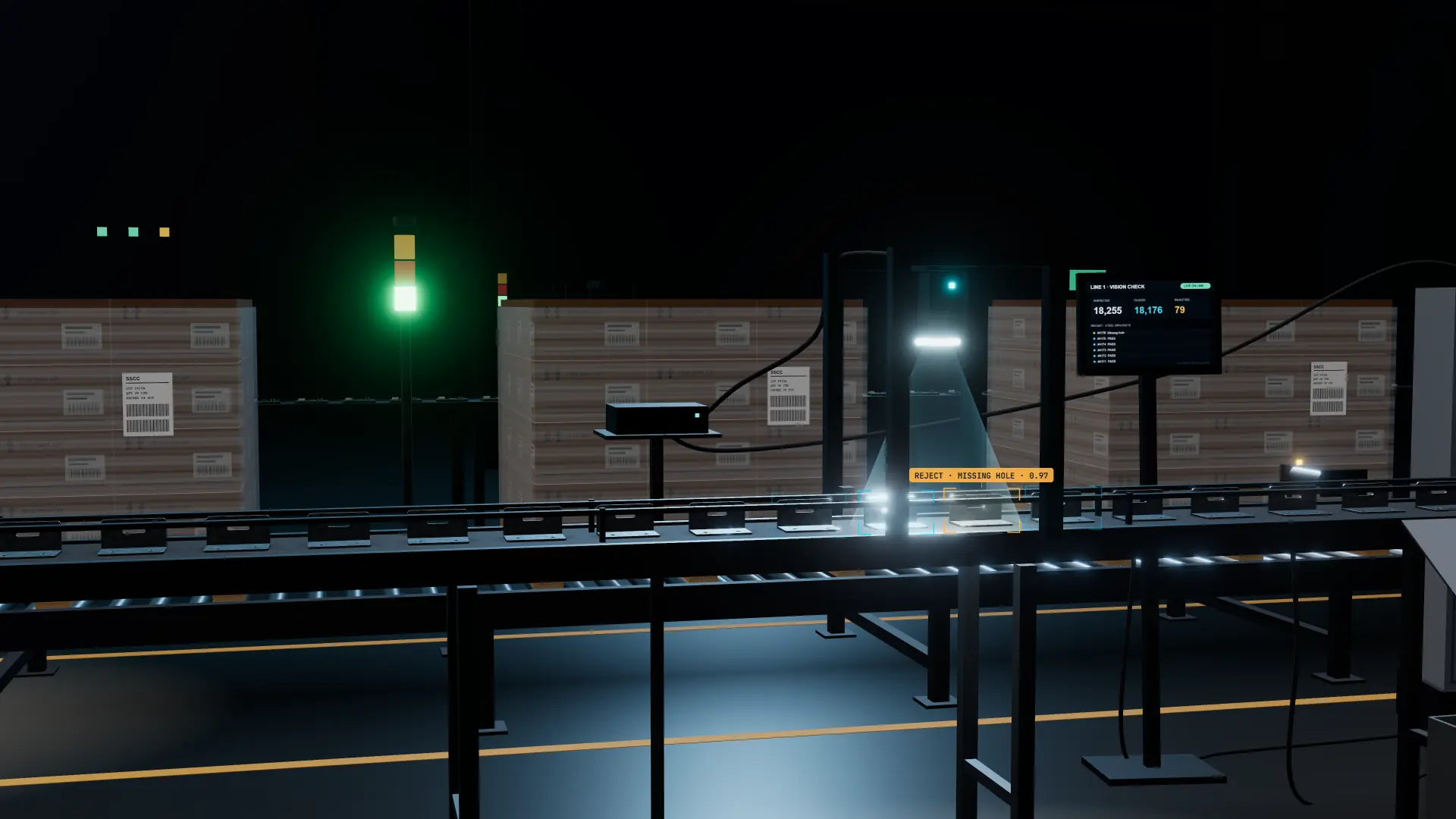
AI quality control for New Zealand manufacturing
Industrial AI Vision inspects every part with a model trained on your products, so defects are caught before they reach your customers.
Updated October 2026 · 3D simulation, illustrativeAI quality control from Industrial AI uses machine vision and a model trained on your own products to inspect every part, identifying surface flaws, missing components and assembly errors inline. Non-conforming parts are removed through your line’s existing reject equipment, and every result is recorded with its image.
- Defect detection
- Surface inspection
- Assembly checks
- Counting
- Quality records
Check every part for the faults that matter
The same checks a good inspector makes, applied to every part on every shift.
Surface defects
Scratches, dents and coating faults found on every part as it passes.
Complete assemblies
Screws, clips and seals checked before the part moves on.
Orientation and position
Parts upside down, reversed or out of place.
Counting
Part and batch counts, shared with line screens and reports.
Colour and finish
Checks colour and finish against the sample your customer approved.
Print and marking
Confirms labels, codes and part marks are present, readable and correct.
Weld appearance
Spots visible weld faults before parts move to the next process.
Shape and fit
Finds bent, short or misshapen parts that won’t fit further down the line.
Assembly checks and error-proofing
The vision system checks each assembly before it moves on, as a camera-based poka-yoke step that reduces assembly errors on high-mix lines.
- Parts present or missing
- Correct part, variant and left or right hand
- Fastener and component counts
- Kit completeness
Your quality team sets the standard
Together we agree what counts as a fault, how strict to be and how the line responds, and the Industrial AI Vision Lab (VLab) trains your model to that standard.
| Fault | What counts | What happens |
|---|---|---|
| Scratch on a visible face | Longer than your limit sample | Reject |
| Scratch on a hidden face | Any length | Log only |
| Missing fastener | Any position | Reject + alert |
| Colour shift | Outside your approved range | Set aside to recheck |
| Part upside down | Any | Reject |
| Not sure | Below the agreed confidence | A person checks |
Illustrative example. Your own table is agreed with your quality team during setup.
- 01
Good parts
Examples of good parts, including the normal variation you accept.
- 02
Borderline parts
The close calls, ruled on by your quality team.
- 03
Real faults
Examples of each fault from your own reject bin.
- 04
What matters where
Which faces your customers see, and which they don’t.
Inspect wherever it suits your line
Parts in motion
Parts are inspected inline as they travel, and non-conforming parts are removed by your reject equipment.
A closer look
Suits assemblies and parts that need checking from several sides.
One last check
A final look before parts move on to packing or the next process. End-of-line inspection.
Use AI where fixed rules struggle
Many plants use both, and each check goes to whichever does it best.
- Faults that vary in shape, size and position
- Cosmetic flaws on textured or shiny surfaces
- Products that vary from one to the next
- Lines with frequent changeovers
- Precise measurement to tight tolerances
- Simple presence checks in fixed conditions
- Reading clear marks in a fixed position
- Checks that already work well today
If you already have a machine vision system, AI can run beside it and take over the checks it finds hard. Computer vision vs machine vision.
Works with the controls already on your line
Industrial AI Vision connects with your line’s control systems and reject equipment, so your plant acts on every result. Each model is validated before it goes into production. How plant integration works.
Keep an eye on the rest of the line
Optional extras that use the same camera AI, each scoped on its own.
Safety zones
Alerts when someone enters a danger zone. It adds to your guarding and never replaces it.
Machine status
Know when a machine stops or faults, read from its lights and gauges.
Flow and throughput
See where the line slows down, jams or runs short of product.
Show auditors exactly what was checked
Every inspection is recorded with its image and time, and automated reports summarise output, rejects and causes for every shift. The records support ISO 9001 quality systems and customer queries; certification stays with your quality team and auditor.
Product-specific models, run at the edge
Each system uses a custom vision model developed in the Vision Lab, trained on images of your own parts and validated on your footage before go-live. Offline edge deployment keeps images within your facility, with no dependence on external connectivity, and cloud or hybrid deployment is available where remote access matters. Edge AI vs cloud AI.
Start with the fault that costs you most
That’s usually the one that reaches customers, causes rework or ties up an inspector. Further reading: how AI quality control works, the computer vision in manufacturing guide, packaging inspection, food and beverage inspection and the production line inspection overview.
Frequently asked questions
How does AI defect detection work on a production line?
Can it measure dimensions?
Can it work with the cameras we already have?
How accurate is AI quality control?
Our parts vary a lot. Will that confuse it?
Can it watch safety zones around machines?
Does it produce records for quality audits?
Related pages and guides
Talk to us about your toughest faults
Tell us what you make and which faults cost you most, and we’ll show you what can be checked.